It's 2:14 AM on Sheikh Zayed Road. A tourist's rental car has spun out near an interchange, and a bystander is dialing 999 with shaking hands, trying to explain a location he doesn't recognize in a language the operator doesn't speak fluently. In the old model of dispatch, this call gets logged, transferred, clarified, and routed — and every one of those steps eats seconds that matter. In an emergency, seconds decide outcomes.
This is exactly the gap artificial intelligence is closing. AI-powered dispatch systems can transcribe and translate that call in real time, pull GPS data before the caller finishes a sentence, flag the injury severity from voice stress patterns, and route the nearest ambulance — all before a human operator would have finished writing the address down. Across the UAE, this shift isn't theoretical. It's already underway, driven by national Smart Government initiatives that treat public safety infrastructure as a core pillar of digital transformation.
This guide breaks down how AI is reshaping emergency dispatch in the UAE — the technology behind it, the agencies already using it, and what it takes to deploy it responsibly.
Key Takeaways
- AI accelerates emergency response by automating call intake, prioritizing incidents, and dispatching the nearest available responders in real time.
- Predictive analytics help emergency agencies anticipate high-risk areas and strategically position ambulances, police, and fire units before emergencies occur.
- Multilingual AI voice assistants support Arabic, English, and other common languages, ensuring faster communication across the UAE's diverse population.
- Real-time integration with GIS, IoT devices, CCTV, drones, and existing CAD systems enhances situational awareness and resource coordination.
- UAE government initiatives, including projects by NCEMA and Dubai Police, demonstrate how AI is strengthening national public safety and smart city infrastructure.
- AI reduces operator workload and human error by automating transcription, incident classification, and repetitive dispatch tasks.
- Modern AI dispatch platforms integrate with existing infrastructure, allowing agencies to modernize without replacing their entire Computer-Aided Dispatch (CAD) system.
- Organizations adopting AI-powered emergency dispatch today will achieve faster response times, improved operational efficiency, stronger public trust, and greater crisis preparedness.
What Is AI in Emergency Dispatch Systems?
AI in emergency dispatch refers to software that automates and accelerates the process of receiving, triaging, and routing emergency calls. It listens to incoming calls, transcribes and analyzes them in real time, scores their urgency, and matches the nearest available responder — police, ambulance, fire, or civil defence — to the incident. The same systems often layer in predictive analytics, forecasting where and when emergencies are likely to spike based on traffic, weather, and historical patterns, so agencies can position resources before the call even comes in.
Why Emergency Dispatch Needs AI More Than Ever
Growing Emergency Response Challenges
The UAE's population has grown fast, and so has the pressure on its emergency infrastructure. Dubai alone hosts tens of millions of visitors a year, and mega events — from global expos to major sporting fixtures — bring dense, temporary crowds into areas dispatch systems weren't originally sized for. Add rapid urbanization, more vehicles on the road, and taller, denser buildings, and you get an emergency response system that has to do more with the same headcount.
Limitations of Traditional Dispatch Systems
Legacy dispatch relies almost entirely on human bandwidth. A single operator can only take one call at a time, triage it manually, and relay details verbally to responders. That creates predictable failure points:
- Long hold times during high-volume periods
- Manual triage that varies operator to operator
- Human error under stress — a wrong address, a missed detail
- Resource shortages during simultaneous incidents
- Communication gaps between agencies that don't share a unified platform
None of these are failures of effort. They're the ceiling of what manual systems can do.
Why This Matters for the UAE
Public safety sits inside a bigger picture here. The UAE's Smart Cities agenda and national resilience strategy treat fast, coordinated emergency response as core digital government infrastructure, not a standalone department problem. It's the same logic driving investment across government IT solutions more broadly — every gap in dispatch speed is a gap in a country's larger claim to being a global model for digital governance.

What Is an AI-Powered Emergency Dispatch System?
An AI-powered emergency dispatch system upgrades a traditional Computer-Aided Dispatch (CAD) platform with a layer of intelligence that listens, understands, predicts, and recommends — instead of just logging and routing. It's the difference between a system that records what a caller says and one that understands what they need.
AI Call Intake
Calls are answered, transcribed, and structured automatically, capturing key details (location, nature of emergency, number of people involved) without waiting on manual note-taking.
Voice Recognition
The system identifies speakers, filters background noise, and picks up vocal cues — including stress or panic — that hint at severity.
Natural Language Processing (NLP)
NLP parses free-form speech into structured data: incident type, injury count, hazards mentioned, all extracted from what the caller actually says, not a rigid script.
Computer Vision
Where video feeds are available — traffic cameras, drone footage, bystander uploads — computer vision can confirm details like the number of vehicles involved or visible smoke.
GIS Mapping
Geographic Information Systems place the incident on a live map instantly, matched against the real-time location of every available unit.
Predictive Analytics
Historical incident data, weather, and traffic patterns feed models that forecast where emergencies are statistically more likely at a given time.
IoT Integration
Smart sensors — from building fire alarms to connected vehicle crash detection — can trigger a dispatch event automatically, without a human placing a call at all.
Put those pieces together and you get what's often called an AI-powered Computer Aided Dispatch system — the modern evolution of the CAD platforms most agencies already run, just with a layer of intelligence sitting on top.
How AI Is Revolutionizing Emergency Dispatch
AI Call Prioritization
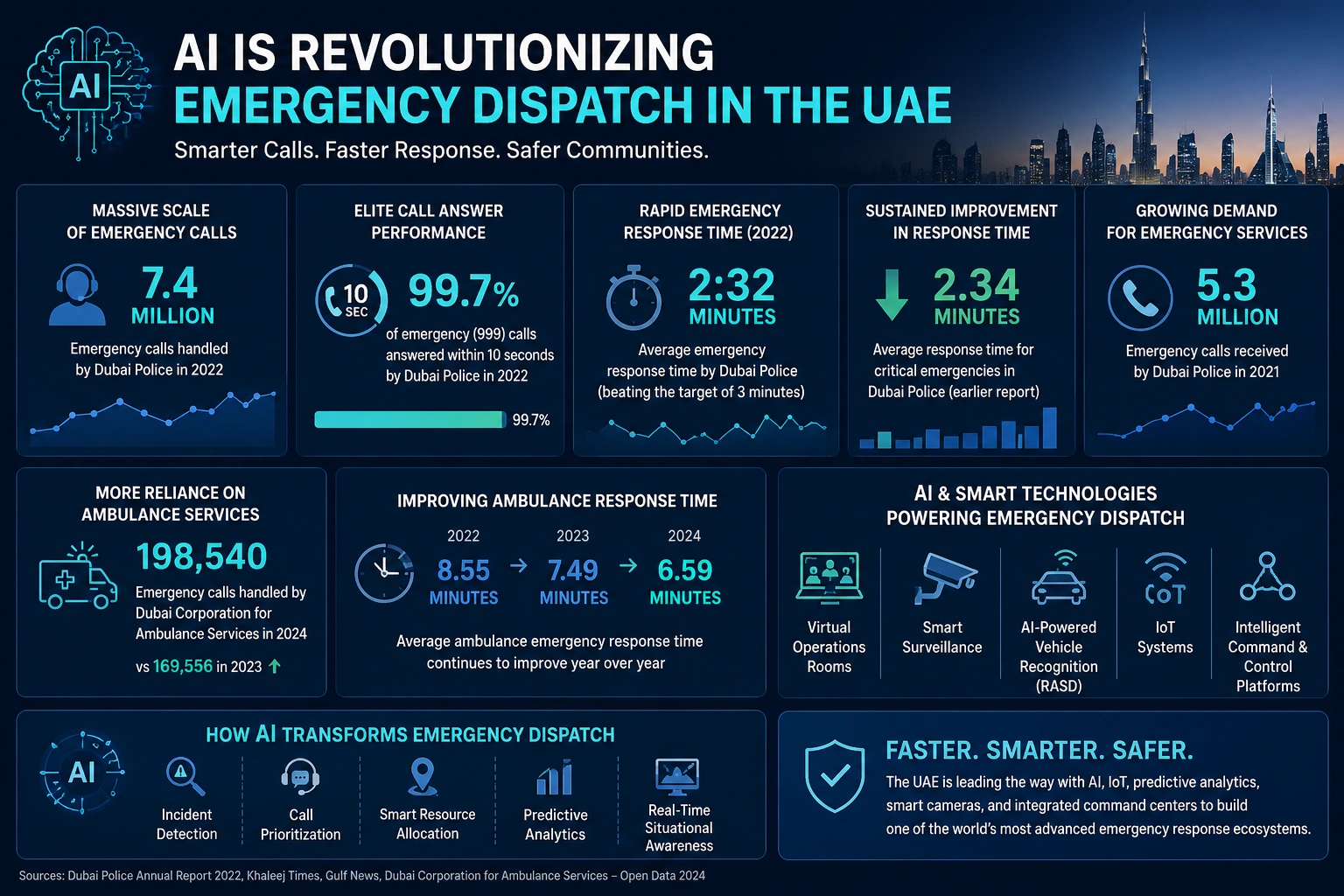
Not every call is equally urgent, but a first-come-first-served queue treats them that way. AI scores incoming calls on severity using a mix of signals: keywords, voice stress detection, and pattern-matching against past incidents. A caller reporting chest pain gets queued differently than someone reporting a fender-bender with no injuries — automatically, in seconds, without an operator having to make that judgment call under pressure.
Predictive Emergency Response
This is where dispatch stops being purely reactive. By layering historical incident data with live traffic and weather feeds, and factoring in scheduled events — a concert, a public holiday, a marathon — agencies can forecast where call volume is likely to spike. That means pre-positioning an ambulance near a known accident hotspot before rush hour, not after the first call comes in.
Real-Time Resource Allocation
Once severity is scored and location is confirmed, AI can recommend — or in more advanced deployments, automatically dispatch — the closest available unit. This spans ambulances, fire trucks, and police vehicles, and increasingly factors in real-time hospital bed availability so patients aren't routed to a facility that's already at capacity.
AI Voice Assistants
The UAE's population speaks dozens of languages day to day. AI voice assistants built for Arabic and English, and increasingly tuned for common tourist languages, mean a caller isn't stuck waiting for a translator during the exact moment that matters most.
Automated Multi-Agency Coordination
Police, fire, EMS, hospitals, and civil defence have historically operated on separate systems, each with its own version of the truth. AI dispatch platforms unify that data, so every agency involved in a response sees the same incident details, live, instead of relaying information over radio calls that can get garbled or delayed.
Real-Time Situational Awareness
CCTV footage analyzed by AI, drone feeds over large incidents, and IoT sensor networks all feed a live operational picture. A commander overseeing a multi-vehicle incident can see camera feeds, unit locations, and hazard data on one screen instead of piecing it together from radio chatter.
Benefits of AI in Emergency Dispatch Systems
| Metric | Traditional Dispatch | AI-Powered Dispatch |
|---|---|---|
| Call handling time | Manual note-taking, slower triage | Automated transcription and structuring, faster triage |
| Resource allocation | Based on operator judgment and available knowledge | Data-driven, matched to real-time unit location |
| Multi-agency coordination | Siloed systems, verbal handoffs | Shared, real-time data across agencies |
| Language support | Limited by available human interpreters | Multilingual voice AI, instant |
| Operator fatigue | High, especially during peak call volume | Reduced — AI absorbs repetitive triage tasks |
| Decision-making | Reactive, based on the current call only | Proactive, informed by predictive models |
| Citizen experience | Wait times vary with call volume | More consistent, faster initial response |
| Operational cost | Scales with headcount | Scales with infrastructure, not just staff |
UAE Success Stories in AI-Powered Emergency Response
NCEMA and Presight
The National Emergency Crisis and Disaster Management Authority (NCEMA) has partnered with Presight, a UAE-based AI firm, on data-driven approaches to national resilience — using analytics to anticipate and manage crisis scenarios rather than only responding to them after the fact.
Dubai Police AI Initiatives
Dubai Police has invested heavily in AI across transport monitoring and rescue operations, using smart systems to flag traffic incidents and coordinate faster interventions on some of the busiest road networks in the region.
Abu Dhabi Emergency AI
Abu Dhabi's public safety agencies have moved toward integrated smart command centers, where AI-assisted monitoring supports faster, better-informed decisions during large-scale incidents.
Sharjah Smart Emergency Services
Sharjah's emergency services have followed suit with smart city integrations designed to connect emergency response more tightly with the emirate's broader digital infrastructure.
What Other UAE Organizations Can Learn
The common thread across these deployments isn't the specific vendor or tool — it's the decision to treat AI as core public safety infrastructure, backed by leadership commitment, rather than a pilot project bolted onto an existing system.
AI Technologies Powering Modern Emergency Dispatch
A handful of underlying technologies make all of this possible:
- Machine Learning models incident patterns and improves prioritization accuracy over time.
- Natural Language Processing turns spoken emergency calls into structured, actionable data.
- Generative AI can draft incident summaries and after-action reports automatically, freeing up staff time.
- Computer Vision reads camera and drone footage for hazards, vehicle counts, and crowd density.
- Predictive Analytics forecasts demand before it hits the phone lines.
- Digital Twins simulate city infrastructure to war-game response plans before an actual crisis.
- Cloud Computing gives dispatch platforms the scale to handle traffic spikes without hardware limits.
- Edge AI processes data locally — in a vehicle or on a sensor — when milliseconds matter more than a round trip to the cloud.
- IoT connects sensors, alarms, and vehicles directly into the dispatch pipeline.
- 5G Connectivity carries the volume of real-time video and sensor data these systems depend on.
Stitching all of this into a single working platform is less about any one technology and more about integration — which is exactly the gap AI-driven IT solutions by SISGAIN Technologies are built to close.
Challenges of Implementing AI in Emergency Dispatch
None of this comes without friction. Agencies evaluating AI dispatch tend to run into the same set of obstacles:
- Legacy CAD integration — older systems weren't built with AI interoperability in mind.
- Data privacy — emergency calls contain sensitive personal and location data that needs strict handling.
- Cybersecurity — public safety infrastructure is a high-value target, and AI adds new attack surface if not secured properly.
- AI governance — someone has to own accountability when an algorithm makes a triage recommendation.
- Regulatory compliance — UAE data protection and public sector standards apply in full.
- Staff training — operators need to trust and understand the tools they're working alongside, not just be handed new software.
- Budget — AI infrastructure is an investment, and agencies need a clear case for ROI.
- Public trust — citizens need confidence that AI-assisted dispatch is making their emergency safer, not slower or less human.
Best Practices for Deploying AI in UAE Emergency Response
- Define clear objectives before choosing a platform — know what "faster" and "better" mean in measurable terms.
- Modernize the underlying CAD system so it can actually support AI integration.
- Integrate Smart City data sources — traffic, weather, IoT — rather than building AI in isolation.
- Deploy multilingual voice AI from day one, given the UAE's linguistic diversity.
- Enable predictive analytics early to start building historical accuracy.
- Secure infrastructure end to end, with emergency data treated as maximally sensitive.
- Pilot in a single district or agency before a full rollout.
- Scale gradually, using pilot data to refine the model before expanding.
None of this happens in isolation from the rest of an agency's technology stack — it's part of a wider push toward digital transformation services and solutions for modern enterprises, where dispatch is one piece of a much larger modernization effort.
Why SISGAIN Is the Right Technology Partner for AI Emergency Dispatch
Building AI-powered public safety infrastructure isn't a generic software project. It requires teams who understand AI development, enterprise-grade software architecture, GIS integration, and government compliance requirements at the same time — and who've actually built for the UAE market.
SISGAIN brings together AI-driven IT solutions, cloud infrastructure, IoT integration, and Smart City system design, with direct experience building secure, government IT solutions in the UAE. It's the kind of track record that comes from working as IT software solutions experts in the UAE rather than treating public safety as a side project — and it's part of why SISGAIN is counted among the more established software companies in Dubaibuilding for government and enterprise clients alike. That combination — technical depth plus regional regulatory fluency — is what separates a working pilot from a system an agency can actually run at scale.
Conclusion
Emergency response is moving toward an AI-first model, and the UAE is already ahead of much of the world in adopting it. NCEMA, Dubai Police, and other agencies aren't experimenting at the margins — they're building AI into the core of how the country manages crisis and public safety.
The agencies and organizations that invest in this now will be the ones with faster response times, better resource utilization, and stronger public trust five years from now. The ones that wait will be retrofitting under pressure, during an incident that makes the gap impossible to ignore.